
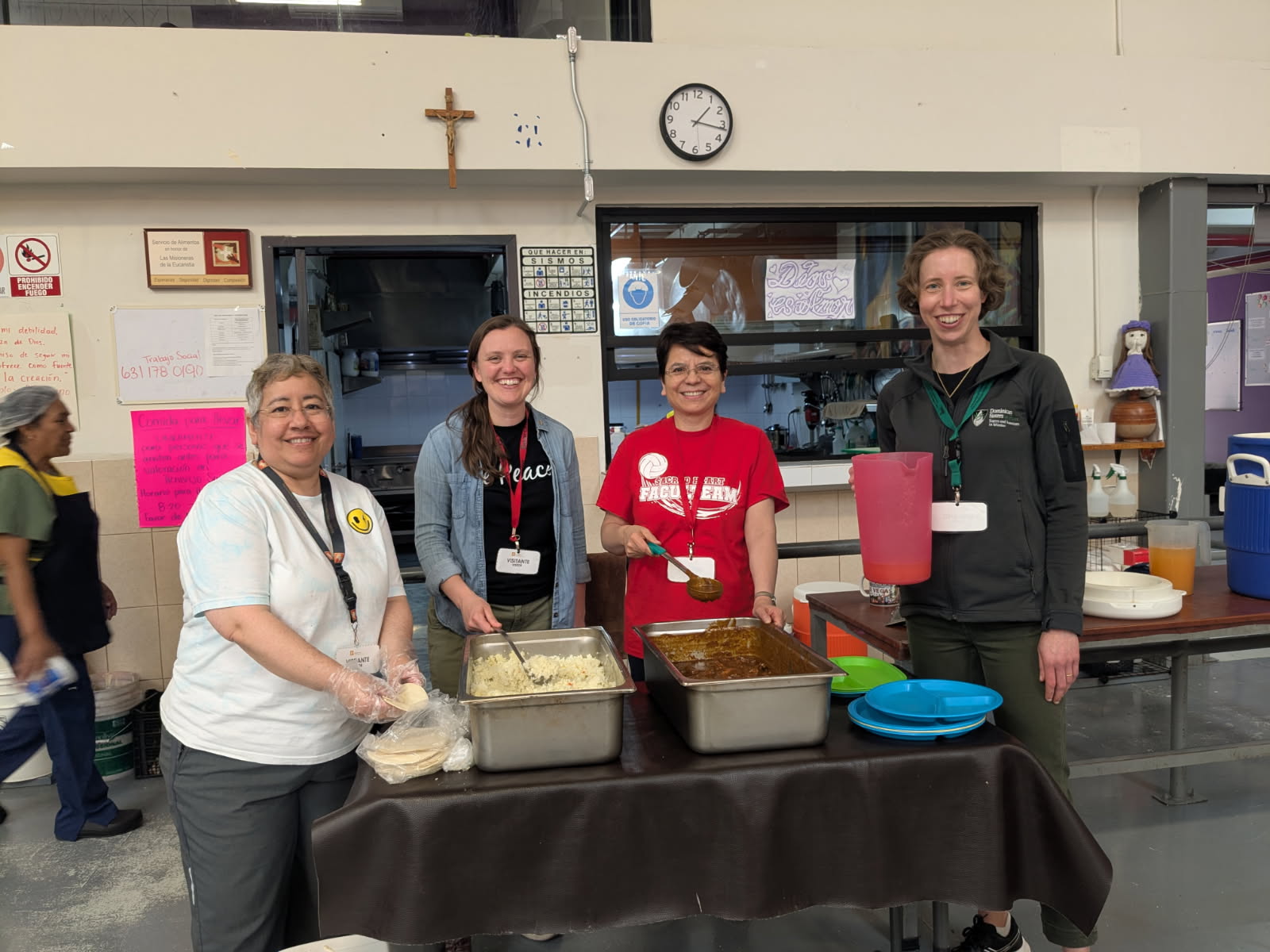
In a recent address to Spanish parliament, Pope Leo XIV addressed the dignity of migrants and refugees across the world.
“The situation of migrants and refugees calls for a response that focuses on people, addresses the root causes that force them to leave, and goes beyond the mere management of migration flows,” he said.
A recent trip to the border cities of Nogales, Mexico and Nogales, Arizona gave three Dominican Sisters of Peace new perspectives on justice and truth with regards to the plight of migrants.
Srs. Gregoria Bueno-Rodriguez, Annie Killian, and Terri Schell all participated in the Catholic Sisters Walking with Migrants program, sponsored by the Kino Border Initiative.
For Sr. Terri, who visited family in Southern Arizona as a child, the desert took on a new light after this experience.
“The purple cactus-covered mountains had become a place of refuge for me, even into adulthood,” she said. “This trip was distinctly different.”
Sr. Terri encountered a different version of Southern Arizona in a man named Miguel (name altered for privacy). After living and working in Tucson for over 30 years, Miguel was recently detained by Immigration and Customs Enforcement officers after a traffic stop.

The physical encounter left him in a wheelchair. After three months in detainment, he was deported to Mexico – away from his wife, children, grandchildren and family business.
In Miguel, Sr. Terri saw pain, but she also saw determination, wisdom, and inspiration.
“With creativity, dedication, and deep listening, we can reshape old stories, policies, and places into new, dynamic futures of hope,” she said.
On the Mexico side of the border, at the Kino Border Institute, Sr. Gregoria met a nurse who treats people deported from the U.S.
“Many arrive with broken ribs and head wounds from blows with a gun,” she recalled. “(Deportees) are denied medication when they suffer from chronic illnesses and are locked up, putting their lives at risk – (they are) victims of a system.”
On the border itself, Sr. Gregoria felt the weight of the migrant journey while looking at the wall.

“Those large, imposing metal bars reflect a divisive and dehumanizing policy,” she said. “I felt a profound sense of helplessness before a system of power in which the poor have no place.”
After seeing a sign on the wall that read, “Without justice, there can be no peace.”, Sr. Gregoria felt a deeper call to follow the congregational motto: “Be Peace. Build Peace. Preach Peace.”
“This is a fitting place where we, the Dominican Sisters of Peace, need to live, embody, and preach the values of the charism, being present where injustice violates human rights and undermines human dignity,” she said. “Only in this way will it be possible to build peace for those who thirst for justice and truth.”
Sr. Gregoria added that the experience was an invitation to join together and commit to the cause of justice and to defending the rights of migrants.
The stories and viewpoints Sr. Annie heard on the ground, on both sides of the border, shed light on the often discussed and debated topic of migration.
In particular, a meeting with a sheriff on the U.S. side demonstrated that media headlines tend to blow things out of proportion.

“I think the point that the sheriff made was, this is not a crisis,” she said. “There’s a media narrative about a crisis or invasion and that’s false news.”
The true crisis, in Sr. Annie’s view, is the many hurdles that are in place to repel attempts at crossing the border. A complicated and expensive legal process, a dangerous and potentially deadly trek across a desert, and inhumane treatment from officers are all meant to suggest that the journey isn’t worth it.
“The whole logic of deterrence – making this as deadly and difficult as possible to try to discourage people from attempting it – it doesn’t work,” she said. “It’s not addressing the root causes of injustice, poverty and violence.”
Sr. Annie encountered a mother who was separated from her breastfed infant and detained for six months, then deported to Mexico. Rather than deporting her children, who are U.S. citizens, to be with her in a country they have never called home, she remains separated with no legal way to reunite with her children.
“That’s an impossible situation,” Sr. Annie said. “I’m in awe of these parents who want so desperately to care for their children and are willing to risk their lives to be reunited with their families. It shouldn’t be so hard.”
While talking to recent college graduates working at Kino, Sr. Annie saw passion and a glimmer of hope that the process might one day be centered on true justice and peace.
“What we’re seeing right now is one very terrible moment in a longer history of not really having pathways to migration,” she said. “But we can continue to work to change the situation.”
Archbishop Paul S. Coakley, president of the United States Conference of Catholic Bishops, added his concern for society’s treatment of the marginalized in a recent address.
“Human dignity is also threatened by the scourge of racism, by abuse, by disdain and contempt, especially toward the poor, the stranger, the condemned, and the outcast,” he said. “The words of Christ that whatever we do to the least among us, we do to Him not only remind us of our duty as Christians, but of the dignity and value the Lord has instilled in every person created in His image.”
In 2011, the Dominican Sisters of Peace adopted a corporate stance calling for immigration reform to “promote justice through solidarity with those who are marginalized, especially women and children, and work with others to identify and transform oppressive systems.”
The congregation calls for comprehensive immigration reform that would provide additional and viable legal avenues for immigration, reunite and legalize undocumented persons, and establish opportunities for permanent residency.
Explorations like the Walking with Migrants experience continue to animate our commitment to support human rights for all immigrants.
I am deeply grateful to our three Dominica Sisters of Peace in their experience of being with migrants. Sr. Terri’s story of Miguel impressed me very much. Sr Gregorio’s seeing the message “that without”
Justice there is no peace” caused her to want to live more deeply being present to those who experience much injustice. And Sr. Anne, stating tha that “What we are seeing now is one terrible moment of not really having pathways to migration.” Let us pray to support human rights for all immigrants. Thank you sister Terri, Gregorio and Annie for your courage and sharing your experiences in the life of migrants. I am very proud of each of you!
Much love and prayer,
Sr. Brigid
Terri, Gregoria, Annie,
Many thanks to each of you for going to and being with the people of Nogales… where one Dominican is, we all are,,,,so very grateful that you represented us..
Peace , Kay Mahady